
REVIEW · MILKY WAY & ASTROPHOTOGRAPHY TOURS
Milky Way Photography Workshop in Acadia National Park
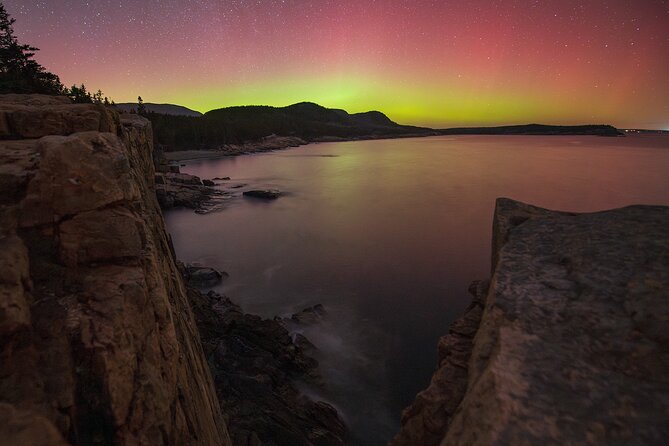
Acadia’s rocky coast and dark sky make a fine classroom, but this is more than a night out with a camera. Christopher guides you through planning, shooting, and editing, so you can return home with a repeatable method rather than a handful of lucky frames. You’ll work at places such as Otter Cliff, Sand Beach, and Jordan Pond, where stars meet recognizable Maine scenery.
I like two things right away: the maximum group size of five, which gives you room to ask questions, and the blend of field work with serious editing instruction. Christopher also covers focus stacking, time-lapse work, foreground exposures, and Milky Way alignment with PhotoPills. The main drawback is the price: $2,500 per person before lodging, meals, and park admission, so this makes sense mainly for photographers who want structured instruction.
Key points for choosing this Acadia workshop
- Five-day instruction with Christopher: You receive field coaching plus a one-on-one post-processing session through Discord.
- Five well-known Acadia locations: The route includes Jordan Pond, Otter Cliff, Bubble Pond, Sand Beach, and Eagle Lake.
- Night shooting at practical hours: Sessions are listed from midnight to 3:30 a.m. and from 7 p.m. to 11:30 p.m., Tuesday through Saturday.
- Advanced image-making skills: Learn single exposures, stacked images, focus stacking, foreground blending, panoramas, and time-lapse techniques.
- Private transport inside the park: You do not need to drive between the shooting sites during the workshop.
- A serious equipment requirement: Bring a DSLR or mirrorless camera, a fast wide-angle lens, a sturdy tripod, and an intervalometer.
What the $2,500 price really buys you
At $2,500, this is not a casual sightseeing outing with a few camera tips. You are paying for a small-group photography course, private transportation inside Acadia, bottled water and snacks, expert instruction, and a one-on-one editing session after the field work.
That price can be worthwhile if you want to build a lasting night photography skill set. The instruction goes beyond camera settings. You learn how to plan the position of the Milky Way, make a clean sky exposure, handle a separate foreground exposure, and combine the files in Photoshop. Those techniques apply well beyond Maine.
The value is less convincing if you already know how to plan celestial alignments, focus in darkness, shoot stacked images, and blend foregrounds in Photoshop. In that case, you may be paying mostly for access to a guide, transport, and selected shooting locations.
Lodging and meals are not included. You’ll need to arrange both in Bar Harbor, and the very late working hours may affect how much energy you have for daytime activities. A valid park pass is also listed at $20 per person. The supplied information calls it a Yellowstone National Park pass, which does not match an Acadia workshop, so confirm the exact entrance requirement before you pay.
More Milky Way and Astrophotography Tours in the USA:
- Mauna Kea: Stargazing Experience with Free Photos
★ 4.2 · 32 reviews - Stargazing and Milky Way Portrait in Capitol Reef National Park
★ 4.5 · 13 reviews - Night Sky Private Photo Tour
★ 5.0 · 8 reviews
Learning the full nightscape process
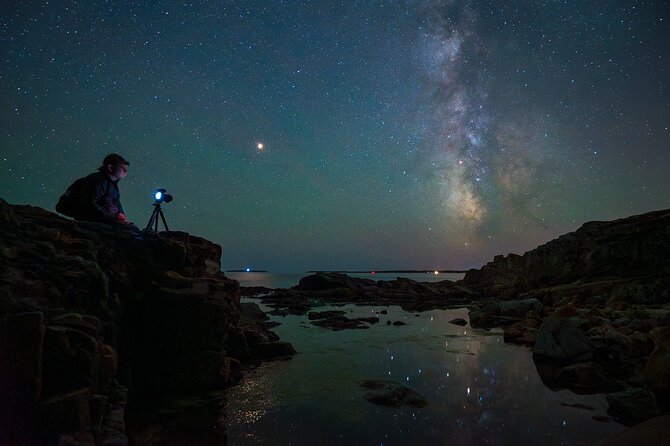
A strong part of this workshop is its complete workflow. You are not simply told to set your camera at a wide aperture and point it at the sky. You learn how to prepare before leaving, make decisions in the field, and finish the image later.
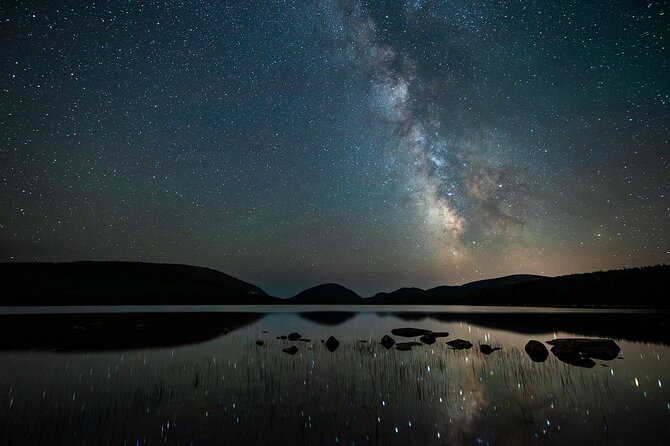
PhotoPills is used to plan where the Milky Way will appear in relation to the coast, cliffs, ponds, and other foreground subjects. That planning matters because the best composition depends on timing and direction. A beautiful foreground can lose its impact if the Milky Way rises in the wrong place.
In the field, Christopher teaches single-exposure and stacked night images. A single exposure keeps the process simple, while stacking several frames can help manage noise and improve detail. The workshop also addresses longer exposures for foregrounds, which can then be blended with a separate sky image.
Focus stacking is another useful skill. You may need one focus point for the stars and another for a nearby rock or shoreline feature. Learning how to combine those frames gives you more control over sharpness than relying on one exposure.
The editing work takes place in Lightroom and Photoshop. You can expect attention to raw-file adjustments, combining exposures, and creating a finished image that still feels natural. The extra Discord session is useful because editing questions often appear after you have had time to work on your files at home.
Christopher has also taught time-lapse photography, including methods for turning changing clouds and moving stars into a sequence. The supplied information notes work with Lightroom and third-party software for time-lapse video. That adds value if you want your workshop to cover moving images as well as stills.
Jordan Pond: reflections, shorelines, and composition
Jordan Pond is one of the planned stops, and it gives you a calmer setting than the exposed coast. The pond can provide a clean foreground and a way to frame the sky with water, shoreline, and distant forms.
For a photographer, the appeal is control. A quiet pond composition can help you practice the basics of alignment, horizon placement, and foreground detail before dealing with rougher coastal conditions. You may find that a simple foreground works better than a crowded one when the Milky Way is the main subject.
The limitation is that water, reflections, and dark shore details can be difficult to balance against a bright sky. That is where separate exposures and careful editing become useful. Do not expect one camera setting to handle every part of the scene equally well.
Otter Cliff: dramatic coast beneath the stars
Otter Cliff brings the rocky Atlantic coast into the frame. It is the kind of location where the foreground carries real visual weight, giving your Milky Way image a clear sense of place instead of looking like a generic star field.
Christopher focuses on storytelling through celestial movement and coastal elements. At Otter Cliff, that may mean using the rocks to guide the eye toward the sky or planning a composition that shows the relationship between the fixed shoreline and the moving stars.
The coast also brings practical challenges. Uneven ground, darkness, and changing conditions call for a sturdy tripod and careful movement. You should arrive with your equipment organized and be ready to follow field instructions rather than spend the first part of the session searching through a camera bag.
More National Park Stargazing in the USA:
- Sedona Stargazing Tours LLC
★ 4.5 · 881 reviews - The Original Sedona UFO and Stargazing Night Tour
★ 4.5 · 269 reviews - The Night Sky Star Story, Galaxy, and Sedona Story Tour
★ 4.5 · 243 reviews - Sedona: Nighttime UFO & Stargazing Tour
★ 4.4 · 148 reviews
Bubble Pond: a quieter setting for careful technique
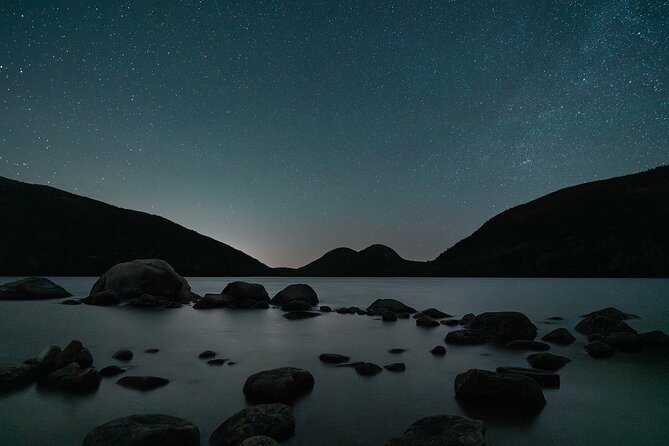
Bubble Pond is another stop on the five-location route. Its appeal is a more contained setting where the sky can share attention with still water and nearby natural forms.
This kind of location is useful for practicing layered compositions. You can work on placing a foreground object, a middle distance, and the stars in one frame. If the sky position changes, the composition may need to change too, which connects directly to the PhotoPills planning lesson.
Bubble Pond also gives you a chance to work on patience. Night photography often involves waiting for the right alignment, checking focus, and repeating an exposure. The small group should help you ask questions as you work, but the process still requires time and concentration.
Sand Beach: open sky and a clear sense of scale
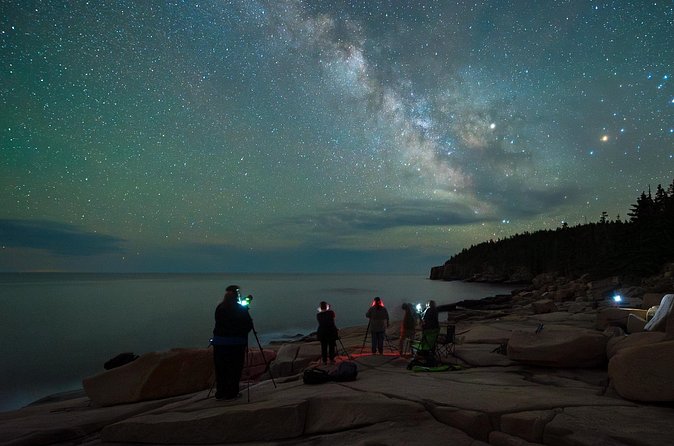
Sand Beach offers a different foreground from the rocky cliff sites. The broad shoreline can make the sky feel larger and give your image a stronger sense of scale.
You can use the beach to explore a more open composition, with fewer visual barriers between the camera and the stars. That may suit a simple Milky Way frame, while a low viewpoint can make the sky feel more expansive.
The tradeoff is that open sand does not always provide as many close foreground details as a rocky shoreline. You may need to work harder to add depth, which is why the instruction on foreground elements matters. A strong night image needs more than a bright band of stars floating above an empty lower half.
Eagle Lake: another chance to refine the frame
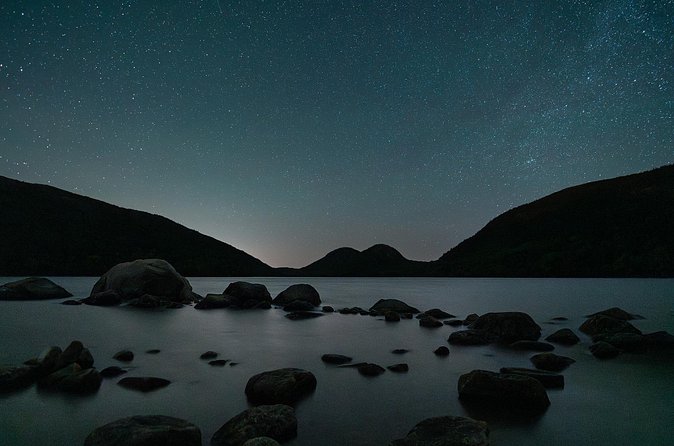
Eagle Lake completes the listed set of locations. Like Jordan Pond and Bubble Pond, it can provide water and shoreline forms that contrast with the sky.
Having several sites matters because night photography is sensitive to conditions and composition. A location that looks ideal in daylight may not suit the Milky Way position at the chosen hour. Moving among several settings gives the workshop more ways to match the sky with the foreground.
You should not assume that every stop will produce a finished masterpiece. The real benefit is the repeated practice: planning, setting up, checking focus, making exposures, and adjusting the composition. That repetition is one of the best reasons to choose a multi-day course instead of a single evening outing.
The late hours require a clear plan
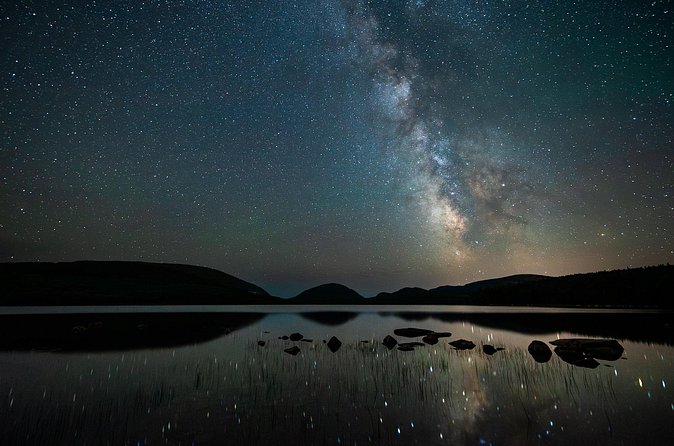
The listed operating times run from midnight to 3:30 a.m. and from 7 p.m. to 11:30 p.m., Tuesday through Saturday, between April 26, 2024 and June 20, 2026. These hours reflect the needs of night photography, but they also shape your entire visit to Bar Harbor.
You may be working after dark for several hours, then returning to lodging while much of town is quiet. Plan your meals and rest with care. Since meals and lodging are not part of the fee, you are responsible for making those arrangements around the workshop schedule.
The experience requires moderate physical fitness. That does not tell you exactly how difficult every site will be, but you should be comfortable carrying camera equipment and working outdoors at night. A sturdy tripod is required, and the coastal stops call for sensible footwear and careful footing.
Private transport covers travel within Acadia during the workshop. That is a real convenience, especially when you are carrying a tripod and multiple lenses. It also lets you focus on the lesson instead of navigating between dark shooting locations.
Equipment you need before arriving
You should bring a DSLR or mirrorless camera capable of long exposures. A wide-angle lens with an aperture of f/2.8 or faster is required, since night work needs as much light as the lens can provide.
A sturdy tripod is essential. Lightweight travel tripods can be convenient, but a tripod that shifts during a long exposure can ruin an otherwise good frame. You also need an external intervalometer unless your camera has one built in.
The course assumes a basic understanding of manual settings and post-processing. You do not need to arrive as an advanced astrophotographer, but you should know how to change aperture, shutter speed, and ISO. It also helps to have some experience opening and adjusting files in Lightroom or Photoshop.
This is not the best choice if you are still learning how to operate your camera in daylight. You will get more from Christopher’s instruction if you can focus on night-specific problems rather than basic menu navigation.
The teaching style and follow-up support
Christopher, also referred to as Chris, is central to the experience. The workshop combines pre-shoot lessons, field instruction, and post-processing help. His teaching is described as calm, patient, and friendly, which matters when everyone is working in darkness and small errors can cost a long exposure.
The follow-up support is a useful detail. The one-on-one Discord session gives you a chance to revisit images after the workshop and ask about decisions made during editing. You can also use that time to apply the process to files that need more work than you could complete during the field sessions.
Past participants have used the instruction for Milky Way stills, panoramas, focus stacking, time-lapse sequences, and video. That range suggests the course is not limited to one narrow type of star photograph. Still, you should confirm how much time will be devoted to each subject if you have a very specific goal.
The maximum of five people is another plus. You are not likely to be lost in a large group, and Christopher can see what you are doing at the camera. Small groups do not guarantee unlimited one-on-one time, but this size gives the course a more personal feel.
Who should book this workshop
I would recommend it to a photographer who already understands manual exposure and wants a structured route into astrophotography. It also suits someone who wants to improve Photoshop blending, focus stacking, panoramas, or time-lapse work while photographing recognizable Acadia scenery.
It is a particularly good fit if you value instruction over a quick photo opportunity. The workshop gives you a method you can repeat at home, from checking celestial alignment to processing the final files.
I would hesitate if your main goal is a relaxed park tour, daytime sightseeing, or a low-cost introduction to Acadia. The late hours, required equipment, separate lodging and meal costs, and $2,500 fee make this a focused course rather than a general vacation activity.
The weather policy offers some protection. If poor conditions force a cancellation, you can receive a different date or a full refund. If the minimum number is not met, the same options apply. You can cancel for a full refund up to 24 hours before the start time, but cancellations or changes made later are not refunded or accepted.
Should you book the Acadia Milky Way workshop?
Book it if you want expert-led practice in both shooting and editing, have the required camera gear, and are willing to work late for several nights. The small group, private park transport, five varied locations, and one-on-one Discord session give the high price a clear purpose.
Skip it if you already handle Milky Way planning, stacked exposures, and Photoshop blending with ease. For the right photographer, this is a serious skills workshop in a memorable setting. For everyone else, the cost may be hard to justify once lodging, meals, and admission are added.
FAQ
Where does the workshop take place?
The workshop is based in Bar Harbor and takes place in Acadia National Park.
How long does the workshop last?
The experience lasts approximately five days.
What locations are included?
The planned stops are Jordan Pond, Otter Cliff, Bubble Pond, Sand Beach, and Eagle Lake.
What are the operating hours?
The listed hours are midnight to 3:30 a.m. and 7 p.m. to 11:30 p.m., Tuesday through Saturday.
How many people can join?
The maximum group size is five participants.
Is transportation included?
Yes. Private transportation is included for travel within Acadia National Park during the workshop.
Are meals and lodging included?
No. You must arrange and pay for your own meals and lodging.
What camera equipment is required?
You need a long-exposure-capable DSLR or mirrorless camera, a wide-angle lens with an aperture of f/2.8 or faster, a sturdy tripod, and an external intervalometer unless your camera has one built in.
Is a park entrance fee included?
No. An entrance fee of $20 per person is listed separately. The supplied details refer to a Yellowstone National Park pass, so confirm the correct pass or fee for Acadia before booking.
What happens if the weather is poor?
If the experience is canceled because of poor weather, you can choose a different date or receive a full refund.
More Workshops and Classes in the USA
- Night & Astro Photography Workshop
★ 5.0 · 2 reviews
More Photo Sessions in the USA
- Mauna Kea Stargazing Experience + Photos
★ 5.0 · 261 reviews - Night-Time Snorkel at TurtleTown with Stars, Lights, and Photos
★ 5.0 · 126 reviews - Moab: The Windows Astro-Photography and Stargazing Hike
★ 4.8 · 36 reviews - Milky Way Photography in Arches National Park
★ 4.0 · 4 reviews
Just added around the USA
- Private Under the Stars Night-Time Tour of DC (Up to 5 Guests)★ 5.0 · 24 reviews
- Stargazing and Milky Way Portrait in Capitol Reef National Park★ 4.5 · 13 reviews
- Temecula Wine Country Stargazing Tour★ 5.0 · 2 reviews
- Skyway Light Show Tour Under the Stars★ 5.0 · 5 reviews
- Astronomy and Stargazing Tour in Utah★ 5.0 · 8 reviews
- PRIVATE Sedona Jeep Tour 4X4 Stargazing Tour at Night★ 4.5 · 11 reviews
- Sunset Sedona Sacred Places -gourmet picnic dinner and stargazing★ 5.0 · 12 reviews
- Private Stargazing – Sequoia National Park★ 4.5 · 14 reviews
Milky Way & Astrophotography Tours, compared.
Mauna Kea: Stargazing Experience with Free Photos
Read our review →
Milky Way, Shark City Island, Beach and Rock Island Tour
Read our review →
Stargazing and Milky Way Portrait in Capitol Reef National Park
Read our review →
Mount Bromo Milky Way Photography and Sunrise Private Tour (1D1N)
Read our review →
Milky Way Sanctuary Stargazing Tour at Pangue Observatory
Read our review →
Milky Way: night snowshoe hike with a typical dinner in a mountain hut
Read our review →Browse the lists this tour appears in