
REVIEW · OBSERVATORY & TELESCOPE TOURS
Cavalleria: Guided Stargazing at the Beach with Telescope
Menorca’s coast becomes a natural planetarium after dark. At Cala Viola de Ponent, far from city lights, you’ll lie on a mattress, learn to find the main constellations, and look through two professional telescopes at objects far beyond the Moon.
I like the mix of science and storytelling, especially the myths tied to Hercules, Andromeda, Cassiopeia, and Draco. I also like the practical side: the guide shows you how to make star leaps and orient yourself in the sky, so you are not simply looking at random points of light. The main consideration is that this is a Spanish-language tour, and one participant wished there had been more direct telescope viewing.
Key points to know
- Cala Viola de Ponent at night: Meet at the beach parking lot, then settle in at a coastal Starlight Reserve away from urban light.
- Guide Gonzo brings the sky to life: Expect clear explanations, constellation myths, and a lively introduction to positional astronomy.
- Two professional telescopes: You may observe nebulae, open and globular clusters, binary stars, and other deep-space objects.
- The Moon changes the program: On moonlit nights, you can study its craters and learn how they formed.
- Spanish is the live tour language: English and French audioguide options may be available, but you must use your own charged phone.
- Weather matters: The session needs clear enough conditions and at least five participants to run.
A dark beach instead of a city observatory
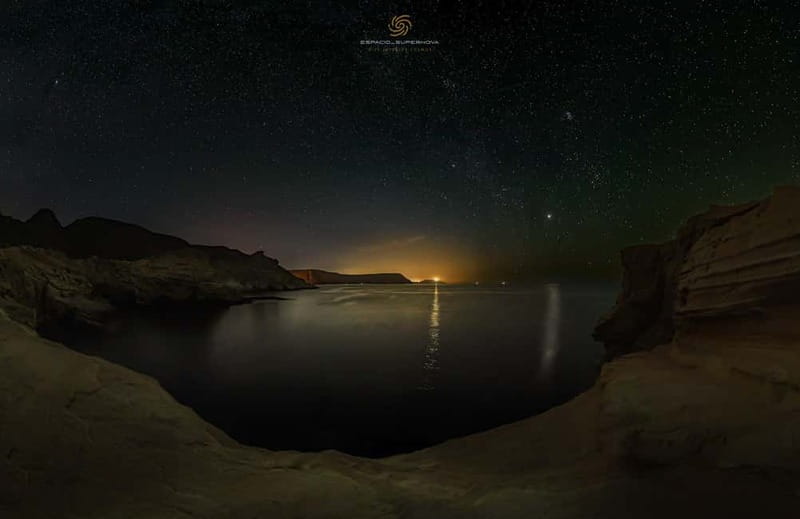
The setting is the first part of the experience. You meet at the parking lot at Cala Viola de Ponent Beach, on Menorca’s coast, rather than at an indoor observatory or a town-center attraction. The Starlight Reserve designation matters because darkness is the main ingredient in good stargazing.
Away from city lights, the sky shows more contrast. Faint stars become easier to pick out, and the Milky Way has a better chance of appearing as a broad band rather than a vague smudge. The exact view will depend on the night, the Moon, and the weather, but the coastal location gives this outing a strong sense of place.
You should arrive ready for an outdoor activity. The tour includes mattresses, so you can lie back and look upward without craning your neck for two hours. That simple detail makes a difference. Stargazing requires patience, and a comfortable position helps you stay focused on the sky.
The meeting point is not a hotel or a central transport stop. You need to make your own way to the beach parking lot, and hotel pickup and drop-off are not included. Check your route before booking, especially if you are staying elsewhere on Menorca.
More Observatory and Telescope Tours in Spain:
- Teide by Night: Sunset & Stargazing with Telescopes Experience
★ 4.5 · 1,492 reviews - Teide National Park: Guided Large Telescope Stargazing Tour
★ 4.9 · 319 reviews - Tenerife: Mount Teide Observatory Astronomical Tour
★ 4.4 · 126 reviews
The first lesson: learning to read the night sky
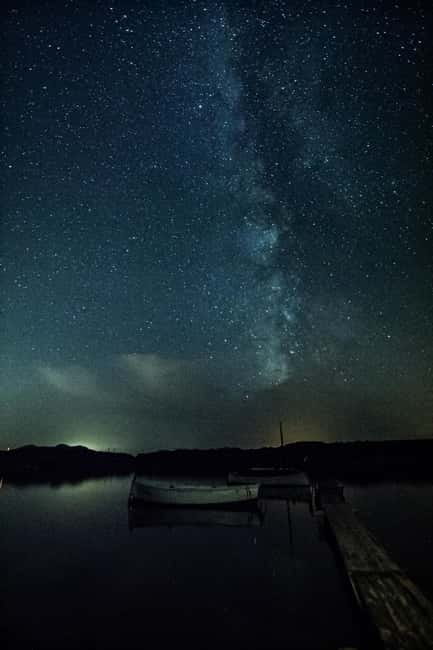
The session begins with the visible sky above you. Your guide identifies the main constellations that can be seen that night, then helps you understand where they sit in relation to one another. This is more useful than memorizing a long list of star names.
The guide introduces positional astronomy through star leaps. In practical terms, you use a familiar star or constellation to move your gaze toward another point in the sky. Once you understand that method, you can start finding things for yourself instead of waiting for someone to point them out.
That approach gives the session lasting value. A simple sky talk can be pleasant, but it fades quickly. Learning how to orient yourself gives you a tool you can use on another clear night, even without a guide or telescope.
The explanations also connect the patterns of stars to ancient stories. Hercules, Andromeda, Cassiopeia, and Draco are presented through their traditional myths, adding a human layer to what might otherwise feel like a technical lesson. The stories help you remember the shapes and locations of the constellations.
Guide Gonzo has been singled out for making the subject interesting for both adults and children. That is important here. Astronomy can become dry when it turns into a list of facts, but this session aims to keep the information tied to stories, visual clues, and the wider question of our place in the Milky Way.
What the two telescopes add
The professional telescopes are the main equipment for the evening. With the naked eye, you see patterns and points of light. Through a telescope, you may examine objects such as open clusters, globular clusters, binary stars, and nebulae.
These categories are worth understanding before you arrive. An open cluster is a group of relatively young stars that can appear scattered across the field of view. A globular cluster is a much denser, rounded gathering of old stars. Binary stars are paired stars orbiting one another, and nebulae are large clouds of gas and dust in space.
The actual objects available will depend on the date, weather, and position of the sky. The experience does not promise the same view every night. That variability is part of astronomy, but it also means you should book this for the process of looking and learning, not for a guaranteed view of one famous object.
A useful point to clarify is the amount of telescope time. The experience includes powerful equipment and a guide-led tour of space, but the supplied information does not promise uninterrupted individual viewing through the eyepiece. One participant specifically wanted more direct observation through the telescope.
If close-up telescope viewing is your top reason for booking, ask the provider how the two telescopes are shared during your chosen session. If you are happy with a mixture of guided explanation, naked-eye observation, and telescope work, the format should suit you better.
The Moon brings a different kind of show
On nights when the Moon is visible, the program can shift toward lunar observation. You may look at its craters through a telescope and learn how those features formed.
The Moon is a useful subject for a first telescope experience because its surface is bright and recognizable. Craters give you something concrete to study, while the guide can explain how impacts shaped the surface. The moonlight also changes the overall mood of the beach.
There is a tradeoff. A bright Moon can be wonderful to observe, but strong moonlight can make faint stars harder to see. If your priority is the Milky Way and dim deep-space objects, a darker, less moonlit night may be preferable. If you want an obvious and impressive target through the telescope, a visible Moon can be a better choice.
This is one reason the activity cannot be reduced to a fixed checklist. The sky changes from night to night, and the guide has to work with what is above the beach.
More Guided Trips in Spain:
- Teide: Guided Sunset & Stargazing Tour by Night with Dinner
★ 4.7 · 1,339 reviews - Fuerteventura: Guided Stargazing Calderón Hondo Volcano Tour
★ 4.7 · 594 reviews - Tejeda: Sunset & Night Sky Guided Astronomy Hiking Tour
★ 4.9 · 37 reviews - Cabo de Gata: Guided Night Walk with Stargazing
★ 4.7 · 36 reviews
Stories that give the stars a human shape
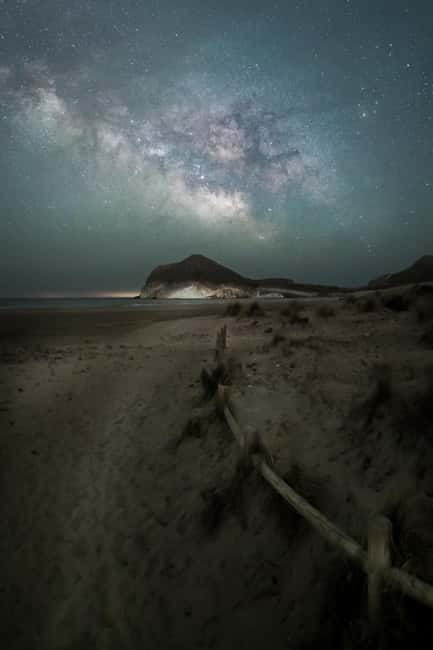
The mythological section is not just decoration. Constellations are arbitrary patterns made by connecting stars that may be at very different distances from Earth. Myths give those patterns a memorable shape and help you recall what you are seeing.
You may hear stories connected with Hercules, Andromeda, Cassiopeia, and Draco. These figures are part of a wider chain of northern-sky mythology, so the tales can also help you understand how several constellations relate to one another.
I like this part because it serves two kinds of visitors at once. Children can follow the characters and creatures, while adults can pay attention to the way the stories shaped human ideas about the sky. The session treats astronomy as both a science and a long-standing human habit.
The guide also places your view in a larger setting by explaining our position within the Milky Way. That can sound grand, but the idea is simple: you are not looking at a separate ceiling of lights. You are looking outward from one small part of a galaxy filled with stars and other objects.
A two-hour pace that leaves room to look up
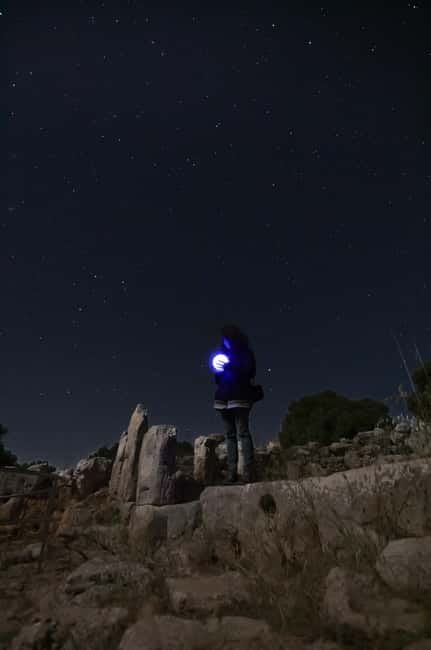
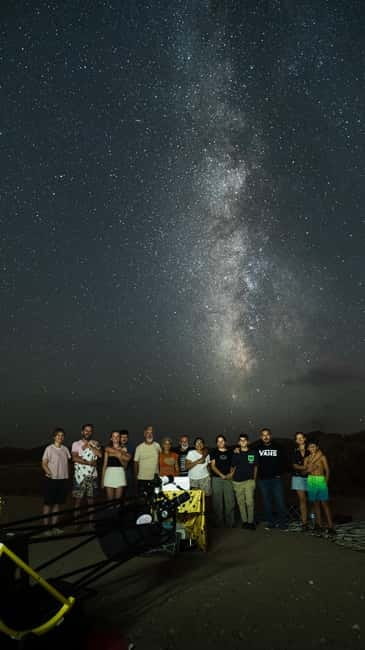
The activity lasts two hours. That is enough time for an introduction, constellation orientation, mythology, telescope work, and a closing photograph without turning the evening into a full-night commitment.
The pace should suit families and first-time stargazers. You get an organized explanation rather than being left to figure out the equipment alone, but the session remains short enough for children who may not be ready for a late, lengthy program.
At the same time, two hours can feel brief if you want long stretches at the telescope. There is teaching to fit in, and the guide may need to share equipment among the group. Set your expectations accordingly. This is a guided introduction to the night sky, not a private observing session with unlimited eyepiece time.
The activity requires at least five participants. If that minimum is not reached, or if weather prevents the session from running, the provider will contact you to reschedule or refund the booking. The clear-weather requirement is not a minor technicality. Clouds, rain, or poor conditions can make the central activity impossible.
Language, comfort, and what to bring
The live tour guide speaks Spanish. If you do not understand Spanish, check the available booking option carefully. English and French audioguide choices may be offered, but the audio files must play on each participant’s own phone.
Bring a fully charged phone, and bring headphones if you have them. The phone is not supplied as part of the activity. This is an easy detail to miss, and a dead battery or missing headphones could make the explanations harder to follow.
Food and drinks are not included. There is also no hotel transport, so plan those parts yourself. The activity provides professional telescopes, mattresses, and a group photo, but not a full evening meal or transport service.
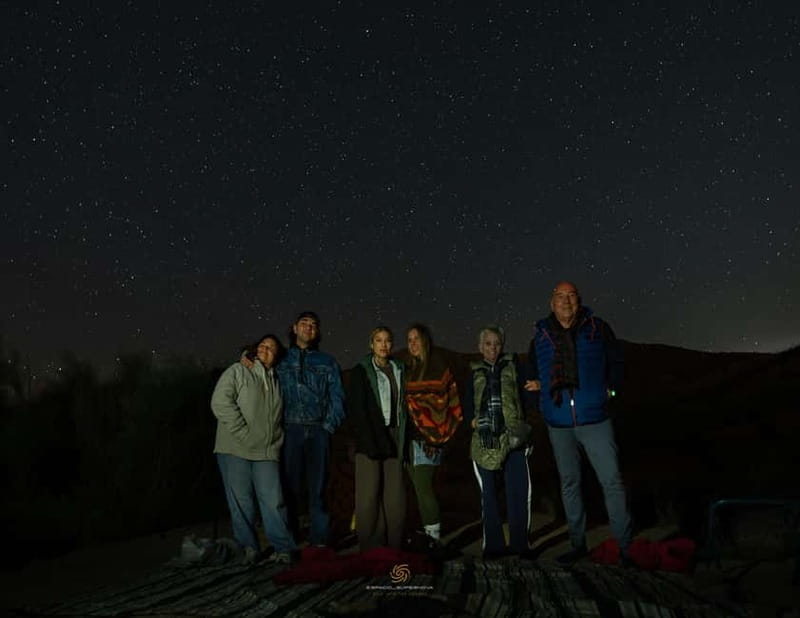
The group photograph, with the stars behind you, is a pleasant final touch. Night-sky photography is difficult without special equipment, so having a group image supplied saves you from trying to capture the same effect on a phone.
The experience is not suitable for wheelchair users. It is also not suitable for people over 95 years old, according to the stated restrictions. If mobility, seating, or late-night comfort is a concern, check the conditions before paying.
Is $35 a fair price?
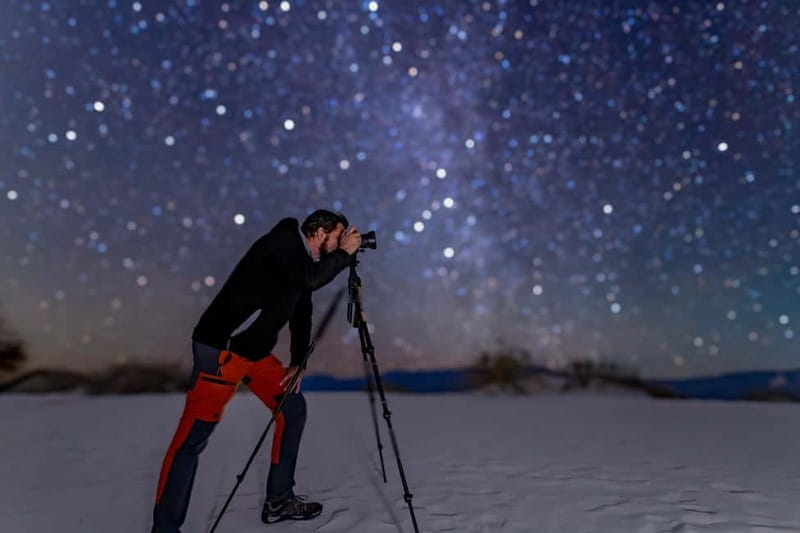
At $35 per person, the value depends on what you want from a night outdoors. You are paying for a certified guide, access to two professional telescopes, instruction in finding constellations, mythology, deep-space observation, mattresses, and a group photograph.
That is a reasonable price for a structured astronomy session, particularly if you are already staying near the coast and can reach the meeting point without paid transport. The setting adds something that an indoor presentation cannot: you are learning under the actual sky, at a dark coastal site.
The value is weaker if you expect a private astronomer, a long period alone at the telescope, or a guaranteed view of a particular planet or nebula. The experience is shared, weather dependent, and shaped by whatever can be seen that night.
I would consider it good value for families, curious first-timers, and anyone who wants an activity beyond beaches and restaurants. It is less suited to an experienced amateur astronomer seeking advanced equipment or a highly technical observing plan.
Who will enjoy this Menorca stargazing experience?
You should consider booking if you like having a guide explain what you are seeing. The combination of myths, star leaps, telescope work, and the Milky Way gives the evening more structure than simply sitting on a beach and looking upward.
Families are likely to appreciate the mix of stories and visual targets. A child may remember Hercules or Draco more easily than a technical explanation, while the telescope gives everyone a reason to keep watching.
The experience also suits couples and solo visitors who want a quiet coastal activity after dark. The mattresses encourage you to slow down, and the two-hour length keeps the commitment manageable.
You may want a different option if your main goal is photography, if you need wheelchair access, or if you cannot follow a Spanish-speaking guide and do not have a charged phone for an available audioguide. You should also think twice if uncertain weather would frustrate you.
My practical verdict
I like this outing because it asks you to look carefully rather than simply admire a view. The guide helps you recognize constellations, connect them with old myths, and understand how to find your way around the sky. The setting at Cala Viola de Ponent gives the lesson a real sense of place, and the telescopes open a window onto clusters, binary stars, and other far-off objects.
The main weakness is the uncertainty around telescope time and language. Spanish is the live language, and the experience may not satisfy you if you expect every participant to spend a long time at the eyepiece. Weather and the five-person minimum also make the plan less certain than an indoor attraction.
Book it if you want a friendly, accessible introduction to astronomy in a dark coastal setting. Before booking, confirm the language option, charge your phone, check the forecast, and make sure you can reach the beach parking lot. With those details sorted, $35 buys a thoughtful two-hour change of pace from Menorca’s daytime pleasures.
FAQ
Where does the stargazing activity meet?
You meet at the parking lot at Cala Viola de Ponent Beach in Menorca.
How long does the experience last?
The guided stargazing session lasts two hours.
What language is the live tour?
The live guide speaks Spanish. English and French audioguide options may be available, depending on the booking choice.
Do I need to bring a phone?
Yes, if you book an audioguide option. The audio files play on each participant’s own phone, so bring a sufficiently charged device. Headphones are also useful if you have them.
Are telescopes included?
Yes. The activity includes two professional telescopes for observing the Moon, when visible, and deep-space objects such as clusters, binary stars, and nebulae.
What happens if the weather is poor?
The activity depends on suitable weather conditions. If it is cancelled, the provider will contact you to reschedule or issue a refund.
Is hotel transportation included?
No. Hotel pickup and drop-off are not included, and you must make your own way to the meeting point.
Just added around Spain
- Villajoyosa: Moonlight kayaking and dinner under the stars★ 5.0 · 5 reviews
- Tenerife Exclusive & Private Gastronomic, Sunset-Stargazing★ 5.0 · 3 reviews
- Small Group Teide Stargazing Tour with Picnic at Sunset★ 5.0 · 3 reviews
- TEIDE NIGHT Astronomy Stargazing Bus Tour, Meal & Drinks included!★ 4.0 · 15 reviews
- “Stargate” Tenerife stargazing★ 5.0 · 13 reviews
- Stargazing Tour in Tenerife★ 3.0 · 2 reviews
- Polestar SELF-DRIVE Sunset Stars Tour in Teide National Park★ 5.0 · 19 reviews
- Private stargazing trip in Teide★ 5.0 · 3 reviews
Observatory & Telescope Tours, compared.
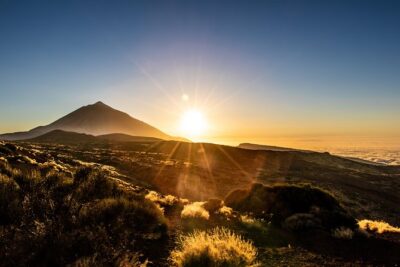
Teide by Night: Sunset & Stargazing with Telescopes Experience
Read our review →
Miami: Frost Museum of Science and Planetarium Entry Ticket
Read our review →
National Park Astronomy Tour with Telescope and Photo
Read our review →
Teide National Park: Guided Large Telescope Stargazing Tour
Read our review →
Levi: Northern Lights Tour and Stargazing by Telescope
Read our review →
Mount John Observatory Stargazing Experience, Tekapo
Read our review →
Houston Museum of Natural Sciences: Planetarium Ticket
Read our review →Browse the lists this tour appears in