
REVIEW · TICKETS
Valley of the Temples under the stars with ticket included
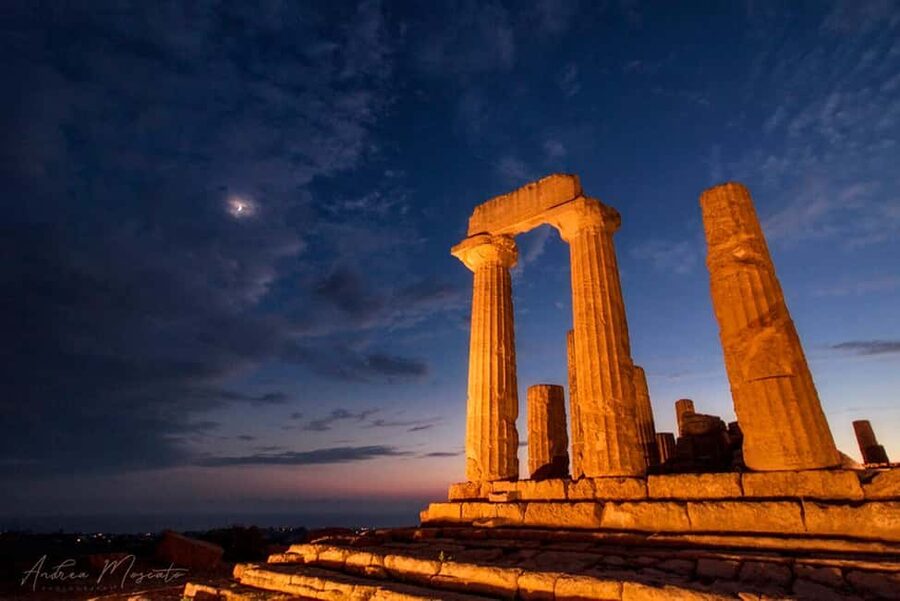
The best thing about this 90-minute night tour is the setting. The Valley of the Temples takes on a different character after dark, with golden lights on the Doric columns and quiet paths between the ruins. I like the route from Hera to Concordia, then on toward Heracles and Zeus, because it gives you a clear sweep through the site rather than one isolated monument.
I also like that your entrance ticket is included and handed to you at the meeting point, so you do not need to sort out admission on arrival. A local guide adds the myths and history that are easy to miss when you walk among the stones alone. The main drawback is practical: the walk appears to finish away from the starting point, and returning to the car park can take about 30 minutes.
Key points to know before you book
- Night lighting changes the entire experience: The columns, ruins, and paths feel quieter and more atmospheric after sunset.
- The route covers the main eastern monuments: You walk from the Temple of Hera past the Christian necropolis and Temple of Concordia, then continue toward Heracles and Zeus.
- Your entry ticket is included: The guide provides it at the olive tree near the Lemonade stand before the Juno Temple gate.
- The guide may speak two languages: Italian and English can be combined in one group, which may add waiting time at each stop.
- Plan for a walk back: The route does not appear to return you to the meeting point, and a 30-minute walk back to the parking area may be needed.
- Arrive 20 minutes early: A late arrival can mean missing the tour because the ticket is valid only at the scheduled start time.
Why the Valley of the Temples works so well after dark
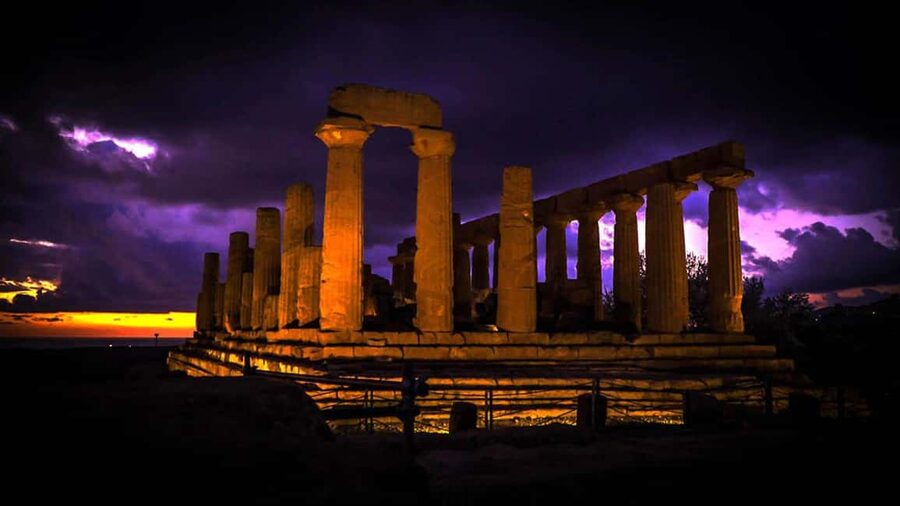
Agrigento’s Valley of the Temples is already a powerful place by day. At night, the experience becomes more focused. You are not looking across a broad archaeological site under a bright sun. Instead, you follow a lit path through ancient columns, broken walls, and open spaces where the darkness hides the modern world.
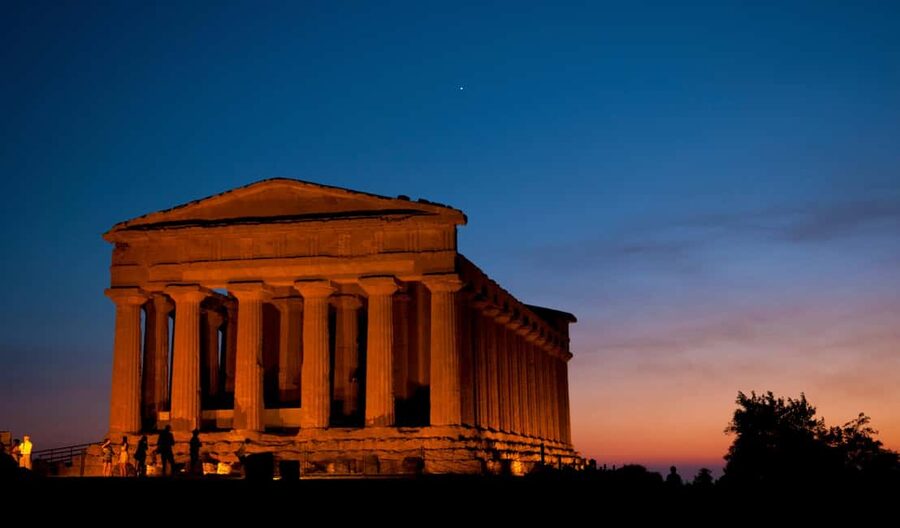
That change matters. The evening light picks out the shape of the ruins without showing every detail at once. The Temple of Concordia, in particular, gains a calm, almost theatrical presence. The quiet also gives the guide’s stories more weight, especially when the subject turns to Greek gods, old legends, early Christianity, and the long afterlife of these buildings.
I would choose this tour if you have already spent the hottest part of the day elsewhere in Sicily or if you prefer historic sites at a slower pace. You should not expect a full archaeological seminar in 90 minutes. You get a compact guided walk with atmosphere, major monuments, and enough context to help the stones make sense.
The experience costs $50 per person. That is more than a basic admission ticket, but the price includes entry and a live guide. The value is strongest if you want help with the route and the meaning of what you see. If you are happy reading signs and walking alone, you may prefer a standard visit. If the night setting is the reason you are coming, the guide and ticket package is easier to justify.
More Tickets in the world:
- Miami: Frost Museum of Science and Planetarium Entry Ticket
★ 4.5 · 429 reviews - Houston Museum of Natural Sciences: Planetarium Ticket
★ 4.5 · 139 reviews - Jasper: Jasper Planetarium and Telescope Combo Tour Tickets
★ 3.8 · 118 reviews
Finding the guide near the Juno Temple entrance
The meeting point is not simply the general entrance. Look for the ticket office at the Valley of the Temples, by the Temple of Juno, also called Hera. You meet the guide under the olive tree in front of the Lemonade stand, before the main gate.
This is a small detail, but it matters after dark. Give yourself time to find the right entrance and the right tree. The instructions ask you to arrive 20 minutes before departure, and I would take that seriously. The ticket is supplied by the guide at the meeting point, and a late arrival may prevent you from joining the walk.
The tour offers skip-the-line access at the ticket office. That does not mean you walk past every queue. Security checks still apply, and you must wait your turn there. In practice, the benefit is limited to the ticketing step, but it can still make arrival simpler.
The Temple of Hera begins the 90-minute walk
The walk starts at the Temple of Hera, often identified as the Temple of Juno. This is a useful beginning because the monument gives you an immediate sense of the site’s scale. You begin among Doric columns and illuminated stone rather than spending the first part of the tour on background information outside the archaeological area.
The guide leads you through the remains of an early Christian necropolis before continuing toward Concordia. That contrast is one of the more interesting parts of the route. The site was not frozen in its Greek period. Later communities reused and reshaped the area, leaving evidence of changing beliefs and customs beside the older temples.
I like this opening section because it sets up the Valley as a place with several layers. You see the Greek foundations, but you also get a glimpse of the centuries that followed. The evening light can make the necropolis feel especially quiet, so stay close to the guide and listen for the explanation rather than treating it as a simple passage between temples.
The first portion is listed as roughly 30 minutes. Since the tour is guided in Italian, English, or both, the pace may vary. If your group combines the two languages, each explanation may be repeated. That can be useful if you want a full explanation, but it also means the group may pause longer than expected at each point.
Temple of Concordia is the visual centerpiece
The next major stop is the Temple of Concordia, one of the best-preserved temples from the classical era. Its strong rows of columns make it easy to understand the basic form of a Greek temple, even if you are not familiar with ancient architecture.
At night, lighting draws attention to the vertical lines and the worn stone. You can appreciate the building as a whole without getting lost in every small fragment. The guide’s explanation is most useful here because the monument looks complete enough to invite questions. Why did this temple survive so well? How did its later use affect its condition? What is original, and what has been repaired? The tour is designed to place the monument within its story rather than leave you with a pretty view alone.
The route offers scenic views along the way, so do not focus only on the temple directly in front of you. The path between monuments is part of the experience. From different points, the columns and hills line up in changing ways, especially under the evening lights.
The Concordia section is also where the bilingual format may be most noticeable. Italian and English explanations can require a repeat at the same stopping point. I would rather have the information delivered clearly than rushed, but you should know that the 90-minute schedule may feel less spacious when two languages are used.
More Stargazing Tours in the world:
- Dubai Red Dunes ATV, Camels, Stargazing & 5* BBQ Al Khayma Camp
★ 5.0 · 21,620 reviews - Sharm El-Sheikh: Ultimate ATV Quad, Stargazing & BBQ Dinner
★ 4.7 · 4,084 reviews - Tenerife: Teide National Park Sunset & Stargazing Tour
★ 4.2 · 3,812 reviews - Tenerife: Sunset and Stargazing at Teide National Park
★ 4.7 · 2,826 reviews
Heracles adds broken stone and scale
The Temple of Heracles comes next. Compared with Concordia, this stop gives you a different view of ancient architecture. You see remains rather than a nearly complete temple, which makes the site feel less polished and more archaeological.
That contrast is valuable. Concordia helps you picture a standing classical temple. Heracles shows how much has been lost, scattered, or reduced to partial columns and foundations. A good guide can connect those fragments to the original building without pretending that the ruins are more complete than they are.
The stop is planned for about 30 minutes, including guided explanation and time to look around. You may find this part less immediately dramatic than Concordia, but it helps you understand the size and variety of the Valley. It is also a good place to pay attention to the open setting around the ruins, where the night silence becomes a major part of the visit.
One guide named in the tour feedback is Luigi, who was described as especially prepared and passionate. Guide assignments can vary, so you should not assume Luigi will lead your departure. Still, the experience clearly depends on the individual guide. The strongest version of this tour will give you more than dates and names, using the myths and legends to make the broken stones easier to picture.
The Temple of Zeus ends among colossal remains
The route continues toward the Temple of Zeus, ending in front of its huge surviving remains. This is not the neat, column-lined image you may have in mind when you hear the word temple. The site is known for its massive fragments, which give you a sense of ambition on a much larger scale.
Ending here is a good choice. Concordia offers preservation and symmetry, while Zeus gives you size and ruin. The final view leaves you with the impression of a monumental project that has been damaged, dismantled, and weathered over time.
The supplied route details give 30 minutes to several major sections, while the full experience lasts 90 minutes. In practical terms, you should expect a steady walk with explanations at the main monuments, not a long free period at each site. If you want to examine every stone or take many photographs, you may feel pressed.
The final location also creates the tour’s main logistical weakness. The path appears to finish away from the Juno entrance, and one return to the parking area took about half an hour. Because the site closes at night, you should think about your return before setting out. No return shuttle is included in the activity details, so do not count on transport back to the starting point.
What the bilingual format means for your evening
The guide service is available in Italian and English. This is helpful if you are traveling with people who speak different languages, but a mixed group can slow the rhythm. The guide may explain each point in Italian and then English, or in the opposite order.
That format can create pauses at the temples. You may hear the same story twice, which is useful if you miss a phrase, but less appealing if you want a brisk walk. The tour remains 90 minutes, so the time is divided between movement, explanations, and language changes.
I would book this with realistic expectations. It is not a private tour, and the guide may need to serve both language groups together. If you want a tightly paced English-only visit, confirm the language arrangement before booking. If you are comfortable with a shared bilingual group, the format is manageable and may add a little extra time to look at the ruins.
Accessibility, timing, and what to bring
The activity is listed as wheelchair accessible. The route still takes place across an archaeological site, so exact comfort can depend on the paths and the conditions on the evening. The available information does not promise a particular vehicle or return service, so ask the provider directly if you need specific mobility arrangements.
The duration is 90 minutes. That makes this a manageable introduction, but it is not a full day at the Valley of the Temples. Wear shoes suited to walking and allow extra time before the start. Since you meet outside the gate, arrive early enough to locate the olive tree, receive your ticket, and join the group without rushing.
A ticket is included, and the guide provides it directly at the meeting point. Nothing else is listed as included, so plan to cover any personal purchases or needs yourself. The Lemonade stand is a useful landmark, but do not assume food, drinks, transport, or other services are part of the tour.
Who should book this evening visit?
I would recommend it to you if you want three things at once: a night visit, a clear route through the major temples, and a local guide to explain what you are seeing. It suits first-time visitors who do not want to work out the site alone, as well as anyone who wants a quieter alternative to a daytime walk.
It is also a good match for people who value atmosphere. The golden lighting, silence, and open setting are not minor extras here. They are the main reason to choose this departure instead of visiting only during daylight.
I would hesitate if you need a simple loop back to your car or if you dislike bilingual tours. The return walk may be tiring, especially late in the evening, and repeated explanations can make the route feel slower. Families should also note that whisper service is not provided for children. If you want that service, you must request it and pay the guide directly on site.
Cancellation is free up to 24 hours before the activity, and you can reserve now and pay later. Those terms make it easier to fit the tour into a changing Sicily schedule, but they do not remove the need to arrive on time. The entrance ticket is tied to the scheduled start.
Should you book the Valley of the Temples at night?
Book this tour if you want the Valley of the Temples to feel quiet, dramatic, and easy to follow. The combination of illuminated Doric columns, Concordia’s excellent preservation, Heracles’ broken remains, and the huge fragments at Zeus gives you a well-shaped 90-minute visit.
The $50 price is fair when you value the guide and included admission, especially for a first visit. I would skip it only if you prefer exploring alone, need a guaranteed ride back to the parking area, or want a single-language tour with no pauses. For everyone else, arrive early, wear comfortable shoes, and treat the walk back as part of the evening plan.
FAQ
How long does the tour last?
The tour lasts 90 minutes.
What is included in the price?
The price includes entrance to the Valley of the Temples and a guided tour.
How much does the experience cost?
The listed price is $50 per person.
Where do I meet the guide?
Meet under the olive tree in front of the Lemonade stand, before the main gate of the Juno Temple entrance.
When should I arrive?
You should reach the meeting point 20 minutes before the scheduled start.
Where does the walking route begin?
The route begins at the Temple of Hera, also called the Temple of Juno.
Which temples are included?
The route includes the Temple of Hera, Temple of Concordia, Temple of Heracles, and the remains of the Temple of Zeus.
What languages are available?
The live guide service is available in Italian and English.
Can I skip the ticket line?
The included ticket provides priority at the ticket office. You still need to wait for the security check.
Is the tour wheelchair accessible?
Yes, the activity is listed as wheelchair accessible.
What happens if I arrive late?
You may not be able to join the guided tour because the entrance ticket is valid only at the scheduled start time.
Can I cancel for a refund?
Yes. You can cancel up to 24 hours in advance for a full refund.
Just added around the world
- Blue Mountains: Stargazing with a Telescope and Astronomer★ 4.4 · 21 reviews
- ( canyon hurghada & stargazing )★ 4.9 · 16 reviews
- Zermatt: Outdoor fondue “group experience under the stars”★ 4.7 · 3 reviews
- Doha: Night Desert Safari With Stargazing and Inland Sea★ 5.0 · 9 reviews
- Villajoyosa: Moonlight kayaking and dinner under the stars★ 5.0 · 5 reviews
- Vincentia: Jervis Bay Beach Stargazing with an Expert★ 4.9 · 19 reviews
- Vialattea: Night Snowshoeing under the Stars★ 4.5 · 5 reviews
- Ubud: Romantic Floating Dinner Under the Stars★ 5.0 · 2 reviews
Tickets, compared.

Miami: Frost Museum of Science and Planetarium Entry Ticket
Read our review →
Houston Museum of Natural Sciences: Planetarium Ticket
Read our review →
Jasper: Jasper Planetarium and Telescope Combo Tour Tickets
Read our review →
London: Royal Observatory Planetarium Show Entry Ticket
Read our review →Browse the lists this tour appears in